March 31, 2026

14 min read
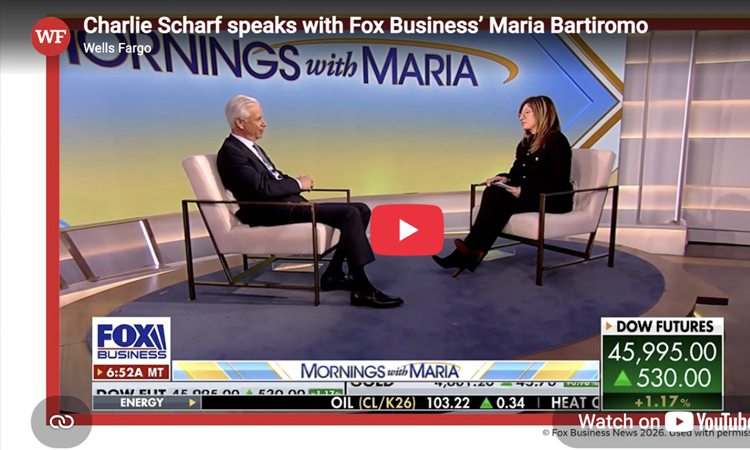
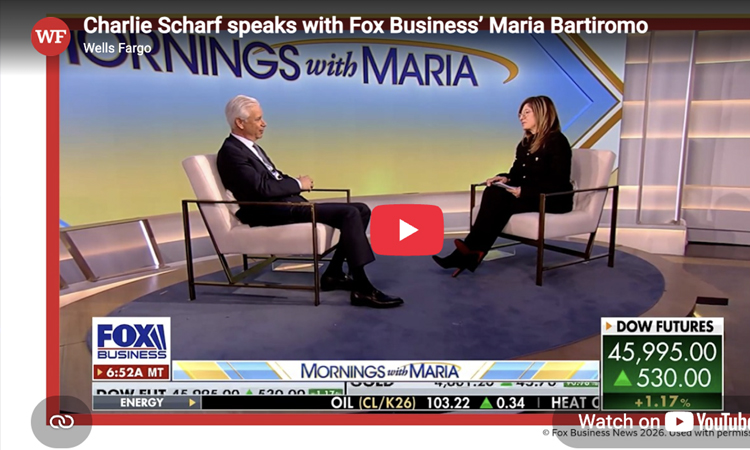
Charlie Scharf speaks with Fox Business’ Maria Bartiromo
Wells Fargo Chairman & CEO Charlie Scharf joined Fox Business’ Maria Bartiromo for an interview on the state of the economy and the strength of Wells Fargo’s franchise.
Transcript
Maria Bartiromo: Charlie, great to have you. Thank you so much for being here. I want to get your take on the impact of this war on the macro story and the economy. What have you seen from your standpoint.
Charlie Scharf: Separate out, the pure economy from markets, what people are nervous about in terms of what the future holds. The economy is still extremely strong. When we look at it, consumers are still spending, even with increases in oil prices they’re spending, you know, 20, 30% more on oil but have not stopped spending on anything else. Delinquencies are still strong, employment strong, wages are still growing, businesses are in good shape. Now it’s still very early on, but just when you just look at the health of the consumer, health of businesses that we serve, which is pretty broad across the country, things are in really good shape. Now, that’s different than markets right. Where you’ve got markets that on one hand, you know, drop in values, you see some nervousness. But you also have this debate about are people factoring in risks of the war enough. That will continue. but it does feel like there is fragility or nervousness in the markets which you don’t yet see in the economy. Depending how long war goes on will either turn out to be okay, or there could be a trigger could make things a little bit worse.
Maria Bartiromo: So, people are waiting to see how long this goes on, and I guess how significant the spike in oil prices becomes. In terms of lending, from your standpoint at Wells, what do you see?
Charlie Scharf: People are cautious about borrowing. By people I mean businesses are cautious about borrowing. Consumers are still borrowing roughly the same rate they were. Credit quality is still extremely strong, and the borrowing that we’re doing at Wells is still within the parameters that we’ve always consistently done. I do think there’s this nervousness, should I be investing, should I be growing inventories, which is holding people back as they’re waiting to see how the war at this point plays itself out.
Maria Bartiromo: You’ve been right in the middle of the excitement of the economy and that is data centers, and financing some of those data centers. There is some worry that there’s so much on data centers, what can you tell us about that. How big of an opportunity is that for Wells Fargo?
Charlie Scharf: You have to step back, there are reasons to worry out there, and you know people always ask about what future is going to hold, and the fact is I think we feel, I personally feel very good about what the rest of the year looks like. Doesn’t mean there aren’t a bunch of risks out there, it doesn’t mean that we can’t be wrong and we’ve got to be prepared for those. When we think about the amount of credit that is being extended in the data center space, when we think about and I’m sure we’ll talk about worries that exist within private credit — those are very real, but, at the same time, there are real underlying businesses with real value propositions. Like anything else in life there are going to be winners and losers, and we are all doing best to make sure that we’re financing and partnering with those that are going to be winners.
Maria Bartiromo: It seems like your location as a California bank gives you great closeness to Silicon Valley. Has that benefited Wells Fargo more than other banks in terms of data center financing.
Charlie Scharf: We’re a national bank. I mean we’ve got large presences in San Francisco, Los Angeles, Minneapolis, Des Moines, Dallas, New York, lots of places. Our customer base is very broad, but I think the most important thing for us in terms of how we position ourselves in this, we’ve had relationships for a long, long time. We’ve banked them, we’ve lent companies money of all sizes, and all types. We’ve got the expertise inside to work with those and bring people together. So, that is really the opportunity.
Maria Bartiromo: Can you convey or characterize the enormity of it, the lending?
Charlie Scharf: Trillions. It’s going to be trillions of dollars, whether 3 to 5 trillion dollars that’s going to be needed to build out the infrastructure. Again, what we understand is there are huge benefits for AI, I mean huge risks and huge benefits, the question what is the business model going to look like to support all that spending? Not everyone is going to get it right, the hyperscales have a huge advantage, those who control large language models that continue on the forefront, continue to invest, people are going to pay for that. And what is strange, at this point is, there’s not this clear understanding of what that business model looks like, so you are doing a bit on the come, but there is no question that the benefits are there.
Maria Bartiromo: Let me get your take on what you are doing at Wells Fargo. I mean a real leadership pivot in terms of where your priorities are, I think, and, of course, you recently had the asset cap and regulatory orders lifted at the bank. What are big opportunities at Wells Fargo now that you’ve got a lifted asset cap.
Charlie Scharf: I think about it like we are blessed with this amazing franchise at Wells. On the consumer side, middle market franchise, our wealth franchise, our corporate investment bank. Even though we have this amazing franchise, we’ve been operating on an unlevel playing field for a very long time because as a bank we lend, take deposits, provide other services but we have not been able to grow. So there’s been a limitation on what we can do for our customers. So now, being able to compete on level playing field opens up the opportunity to serve customers in ways so that means lending more for sure, taking deposits we weren’t able to take in the past. And using that broad set of capabilities to just deeply penetrate consumers and businesses. So, we are incredibly excited about our opportunities to grow all of our businesses.
Maria Bartiromo: So, does this open you up to perhaps acquire a regional bank?
Charlie Scharf: We’re not focused on acquisitions at this point. I think we are in a very unique position, we have this amazing franchise, we’ve been constrained, we don’t feel the need to do any M&A whatsoever. We have a complete business with scale, depth, and breadth with everything that we do. We have this great opportunity to grow organically, so other people are in different positions. We are lucky to be in this position having opportunities with what we have.
Maria Bartiromo: Talk to us about regulatory backdrop in terms of credit card business. The president came out with this idea of a 10% cap on credit card rates. Do you think that materializes and how does that impact things?
Charlie Scharf: I think the president is right to focus on affordability. I mean that’s where he is. He suggests lots of things in terms of how to get there. The administration broadly and the president are very open-minded towards trying to figure out what the best solutions are. I personally don’t think that is the best solution I think there are other things that we can all do to help with affordability. And that’s the conversation that we engage when we talk with administration and lawmakers.
“We lend to the Fortune 500, we manage their cash, we give them advice. And at the heart of what we do is we help provide them capital.”
Maria Bartiromo: One analyst said that if that goes into effect going to cut earnings between 6 and 18%. How much impact does that have on Wells Fargo?
Charlie Scharf: I am not worried about impact on Wells Fargo. We have an important credit card business. It is not the biggest part of the company even though we think we have got great opportunity. I am much more concerned about is it the right answer for helping Americans who are in need. And does it actually help extend more credit or extend less credit? My fear is that it actually hurts the extension of credit.
Maria Bartiromo: Very good point. Let me get your take then on markets, the opportunity there. Because I think you at KDW conference said that is huge opportunity to grow your markets business. How do you do that?
Charlie Scharf: I think you’ve got to put it in perspective. As a bank that serves companies of all sizes, that is the genesis of what we’ve been. We started out very locally, all these banks came together, we serve consumer, we serve small businesses, we serve large businesses. As they’ve grown, we continue to do that. We lend to the Fortune 500, we manage their cash, we give them advice. And at the heart of what we do is we help provide them capital. The idea that we are going to continue to grow out our investment banking and trading capabilities is a continuation of being able to give access to capital for the relationships that we already have. We are incredibly excited about the quality of the people that we’ve been able to bring into the company, letting the great people that have been there have access to more resources to grow, and you see the impact. I mean we’ve gone from, I think 2.7 to 4.4%, you know, market share. In M&A we were involved in two of the biggest M&A deals last year for the biggest 10. It is going to be lumpy for sure. We are growing our equity franchise, we’re growing our leveraged finance franchise, we’re serving sponsors, but it is not something new, it is a continuation of what we do and what our clients expect from us.
Maria Bartiromo: Is it about getting the right people, continuing to gain more of the right people, to actually, you know, increase that business? M&A, increase the number of IPOs that you can do. Is that the big opportunity right now?
Charlie Scharf: It is a combination of getting the right people, making sure we are coordinated across the institutions, so as you develop a primary business in the underwriting side you need secondary business to support that. You can’t do one without the other. Research matters. All these things come together to help build what is a more complete franchise. And we have to be more willing as a management team to commit the resources. That could be hiring people, paying people properly, it could be balance sheet. I would say all in the context of what is right from the risk perspective for Wells Fargo, we’re not looking to exponentially change the risk profile of the company. We’re looking to continue to build upon what we’ve built over a long period of time in a very rational way.
Maria Bartiromo: I want your take on the proposals out of the Federal Reserve. We spoke with Miki Bowman here last week she talked about capital proposals she put out. So, what does this mean for you in terms of managing capital post these Basel III rules?
Charlie Scharf: I think the way they are going about this analysis on capital is exactly what you want. They’re not thinking about it politically, they are not drawing conclusions just because of what someone whispers in their ear. They are doing economic studies, they’re looking at what they think is best for the safety and soundness of the system and what’s going to help banks support growth of the economy. So, you know, putting out several hundred pages of economic analysis to support what they’ve done is incredibly important, putting it out for comment for the public to see, engaging in all types is exactly what you want to see. Ultimately, what it is going to allow us to serve more consumers and more businesses. I mean when you look at risk weighing changes that are proposed on mortgages, auto loans, loans to middle market companies in this country it much more aligns with our view of the risk profile of those underlying assets. We still have incredibly strong capital requirements and still have substantially more capital than we had during the financial crisis, but it is a very prudent way of marrying up safety and soundness and making sure that the banks are positioned to drive economic growth.
Maria Bartiromo: So, do you change the way you manage capital? Right now, you’ve got CET1 ratio 150, 200 basis points above the required ratio, do you change that, do you pull that in?
Charlie Scharf: I think over time probably we will probably operate with slightly lower capital levels because we have had this very big buffer not knowing what is going to happen to capital. Last administration wanted to increase capital materially, now we see where this is. Once this is done, we will be more definitive of what we want to do. What we’d love to do is not just buy stock back and increase dividends but to actually use it to support our customers. We’ve been hindered because of the asset cap, not just capital requirements. So, for us it’s an incredibly exciting time to deploy all this capital into supporting consumers.
Maria Bartiromo: I liked your comment the other day, the world is your oyster. Let me get your take on private credit. People are worried about the bank’s exposure to private sector through your non-depository overhead loans category, what can you tell us there? How exposed is Wells Fargo?
Charlie Scharf: Private credit is a very complicated set of conversations because people are confusing liquidity, they’re confusing credit, they’re confusing mistakes that get made in underwriting which aren’t systemic, and there’s ultimately what it means to retail investors that have been buying this. You think about just liquidity for a second. Which is most of what you’re hearing in the news today. It has nothing to do with credit. It has to do with people are nervous about what is going on, partially because of mistakes underwriting away from the private credit market, partially because of a fear of what happens to the software companies. The fact is, a lot of people have invested in products they think are “semi liquid.” There is no such thing. There is either liquidity or not liquidity. People are coming to terms with that. In terms of pure credit, the reality is, credit is still very, very good. Now there is a lot of credit that has been extended in the private credit space. A bunch of that’s been supported by banks, but like all credit it is not all created equally. There are some really smart people out there who have been through cycles who do it really, really well. Who have got diversification within their portfolios, they’ve got low leverage ratios, you know those are the folks that we try and bank, those folks will do really well for this.
There are others that with a flight of capital that’s come through both institutions and retail looking to deploy assets, have not been as good, there will be some losses there. We don’t see those yet today. What we actually see is relative strength continuing, you get nervousness because of the view of what software companies and what their future looks like. You’ve got this view of there’s been some credit mistakes that have been made but they’re not systemic yet and they’re not systemic to an institution or the marketplace. So, when we look at our book, it is very diversified. Most what we do is subscription finance, where you’re lending to funds that are backed by large institutions that support it. Then we look at loan by loan in terms of what we finance as an individual company and hopefully do it as well as we think we do, does not mean we won’t make mistakes.
Maria Bartiromo: Thank you so much, Charlie. We’ll be right back.