August 04, 2026

16 min read
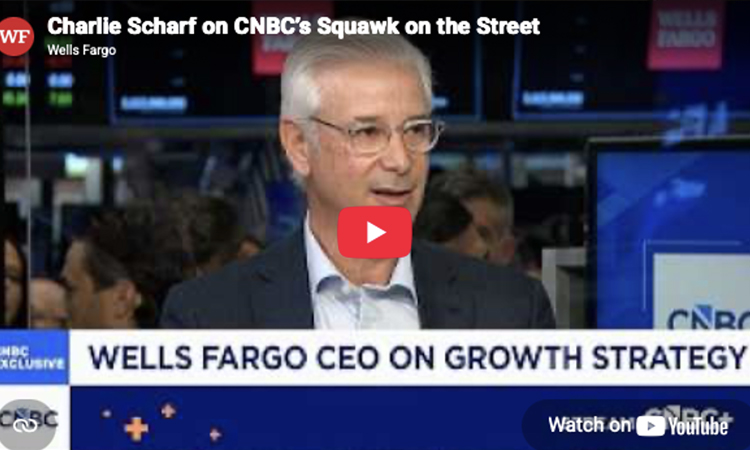
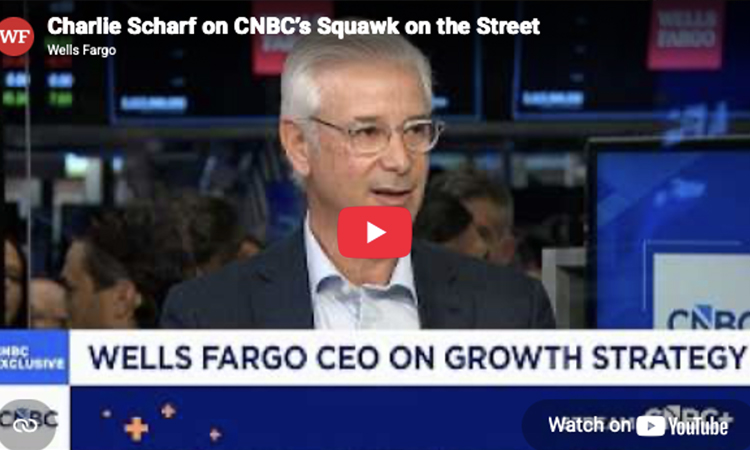
Charlie Scharf on CNBC Squawk on the Street
In a CNBC interview, Wells Fargo Chairman & CEO Charlie Scharf shares how continued investments across the company are driving growth, accelerating market share gains, and strengthening performance across businesses, from consumer banking to investment banking. (16:17)
Transcript:
CNBC: Here on set for a CNBC exclusive is Wells Fargo Chairman and CEO Charlie Scharf. Charlie, welcome to the show.
Charlie Scharf: Thanks for having me here. It’s great.
CNBC: All right. So, there is news here. You’re offering tokenized deposits, and I want to know what competitive edge this gives you — or are you just trying to get ahead of customer demand? I know that JPMorgan has talked about it. You’re ready.
Charlie Scharf: Yeah. Listen, I think when you look at all the banks, we all recognize that tokenization and blockchain technology are real. We’ve been saying that for a long time. You’ve got those outside the banking space saying they’re the only ones doing it, that the banks don’t get it — and that’s just not true. We’re all embracing it. We’re all building solutions. This is an example of what we’re going to be doing to allow our customers to move money more freely, to settle in real time, operate 24/7, starting in the fall and then expanding into 2027. We’re doing it ourselves, but we’re also very excited about working with other banks and just having it be a better way for our wholesale customers to move money.
CNBC: Are they asking for it, or are you going to sell it to them? Are you going to pick up business because of this?
Charlie Scharf: They’re asking about it because they’re curious about it. They’re not asking about it because they think there’s a huge benefit to them yet, and that’s on us to show them that it’s beneficial.
CNBC: Speaking of showing something that’s beneficial, when I go over the conference call — the earnings call — there were so many questions about net interest margin. They didn’t listen to you. You were trying to grow the bank. Yes, that’s actually dilutive to net interest margin. But the growth of the bank beyond just being a plain-vanilla commercial bank is the future. Could you lay out to our viewers why your view is right and the minuscule picking view of the analyst is wrong?
Charlie Scharf: First of all, I do want to say we care about what everyone thinks, but it’s on us to explain what our strategy is. What we’re focused on is growing revenues at the company over a sustainable period of time and growing returns. NIM is more of a byproduct of that.
The fact is, we’ve been so constrained for so long. We were able to go add a bunch of assets in our markets business, which has lower NIM but still has very high returns and will bring additional business. Now, that’s not going to go on forever. We understand that the world is concerned about NIM, so that’s something we’re going to be very focused on. But our laser focus, has been since we got to the company, has been creating an entity that grows faster and has higher returns. That’s what we’ve delivered, and we’re going to continue to deliver that and hopefully tamp down the concerns about NIM.
CNBC: One last question before I turn it over to my colleagues. Since the cap was removed on June 3 of last year, Wells’ stock is up 14%, Citi is up 74%, Bank of America is up 39%, and JPMorgan is up 33%. What are we missing — that your bank is the worst of the major banks?
Charlie Scharf: First of all, when you look at stocks, you know as well as I do that the day you start the clock has a huge difference. We’ve performed extremely well since probably — I got to the company in 2019, so if you look at it since probably 2021, the stock has done unbelievably well.
Ultimately, what’s going to matter is our performance. When you look at our results, our earnings per share are up 25%. We have really strong revenue growth. Expenses are up 2%, but only because commissions expenses are up, so expenses are really controlled. We’re growing loans. We’re growing deposits. We’re growing bankers. We’re growing traders. We’re taking market share in investment banking. Our markets revenue is up 24%. Our banking revenue is up 20%.
Over a period of time, those are the things that drive the stock price. You’re either going to increase the value of the stock by increasing the earnings or the P/E. We’re working on increasing the earnings, and we believe the P/E will grow as our growth grows and our returns grow. The market will reward that over a period of time. We feel really great about the prospects — as great as we have felt consistently since we’ve been on this journey of putting our issues behind us.
CNBC: You mentioned investment banking. Let me start there, or come back to that as well, because you did hit a new record in terms of fees. Obviously, a lot of the large banks had very strong quarters when it came to that. I’m curious: Is it a new baseline in terms of your activity in the capital markets and M&A advisory, or is it a cyclical peak, in your opinion?
Charlie Scharf: When you separate out the industry versus us, there’s no question that a rising tide lifts all ships. Everyone participates in that, but the tides do go out at some point. The things that we’re seeing in our business are core relationships. We’re doing deals for our middle-market customers. We’re doing business for large corporate customers that we’ve had strong relationships with for a long period of time.
So we believe when the markets aren’t as exuberant as they are today, we’ll be impacted, but hopefully less than others because we’re building an underlying franchise. That’s what everything is that we’re doing. If someone is just looking for a trade in tomorrow’s equity volatility or tomorrow’s investment banking IPOs, that’s not us. If you’re looking for a bank that’s going to grow consistently over a longer period of time and produce superior returns, those are the investors we want to attract, and we’ve got a high degree of confidence that’s what we can get to.
“Every one of our businesses is growing because we’re investing in them.”
CNBC: Charlie, let me get your broader view for a moment, because we are in a unique time, it would seem, for the capital markets and for the economy overall. These capex numbers are the likes of which those of us who’ve been in this business for a long time have never seen. Companies that were once among the most profitable now are actually going negative cash flow to fund what they see as the need. How do you view it, and is there risk building overall in terms of all of that spending going toward something with an uncertain return?
Charlie Scharf: I think both sides of the conversation are right. There is an incredible importance to do this. There will be significant payoffs, but there’s also a huge amount of risk being taken because everyone’s piling into it. Not everything is structured the same. Not everyone has the revenue model that’s going to support this. Understanding who the winners and losers are is incredibly difficult.
What we work really hard to do is not just pick the winners and losers, but within the structures of the transactions we lend to, make sure we are supported by people that we believe have revenue models that can pay us back. I think this is one that’s going to take a long time to support out. It is real. The benefits are real. It takes a lot of money to invest in it. There is a payoff at the end. But looking back at what happened in the dot-com era
CNBC: On the call, you made a distinction about lending to a chipmaker, I guess, that has 80% margins as opposed to someone else in the supply chain that is going to take — these are your words — 15 years to get paid back.
Charlie Scharf: Someone that’s going to take 15 years to get paid back is taking a very different credit decision. They’re getting paid a lot more for it. There are some very smart people out there who know how to underwrite these things; others not as much. There’s a lot of money piling into this. We’re trying to stick to what we know, which is where we have line of sight to strong companies that we want to support, that will pay us off, and then we’ll be there to help them the next time.
CNBC: You said the benefits are real, and it sounds like you’re speaking from experience. Is the ROI picture filling in for you?
Charlie Scharf: Totally. It’s remarkable, actually. Quarter by quarter, when we go through our results in terms of what we’re projecting to use for AI, the benefits we’re going to get are hugely substantial.
Our headcount since I’ve been at the company is down 79,000 people. We’re down 15,000 over the past year 7,500 over the last quarter, and that has nothing to do with AI. We still think we’ve got benefits from just running the company better. But when we think about the ability to automate roles and to perform those roles in a way that produces better answers for the people who work at Wells and for our customers, it’s going to result in tens of thousands of less positions.
Now, yes, there are other places where we want to grow where we can apply that. My concern is that this isn’t just for Wells. This is a broader issue. I do believe this is a great thing for the economy, but the time periods might not match up, and the skill levels might not match up. We all have to work really hard in private industry and with government to figure out how we’re going to bridge that gap. But there’s no doubt I think, we’re going to be huge beneficiaries of AI, and our clients will be huge beneficiaries.
CNBC: Do you have a view as to how great the disruption might be, even if it’s short term?
Charlie Scharf: I think it’s hard to tell. The benefit we’ve got going into this is that consumers are really strong. Jobs are there. Wage growth is higher than inflation. I heard Secretary Bessent earlier talking about the K-shaped economy is no longer real. The data that we see totally supports what he says.
When we look at our debit card and credit card spend, our credit card spend is up 10%. Our debit card spend is up 7%. Our credit card spend is not just affluent customers. Affluent, mass affluent, and mass-market customers each are driving about a third of the spend. On the debit card spend, about 70% of the increase in spend is from mass customers, so everyone is spending more. Delinquencies are down. Savings rates are up. Yes, consumer confidence should be a message for all of us
CNBC: We got a savings rate number last week in the twos. It hasn’t been much lower in decades. You don’t have a problem with that? It’s not what you’re seeing?
Charlie Scharf: No. What we see is, as I said, savings, deposits, delinquencies coming down, payments going up. People are concerned, but now they’ve had tax refunds, which have been a huge benefit. Again, I come back to: They have jobs. What we see in the data, because we look at average direct deposit paychecks, is paychecks rising faster than inflation for our customer base.
CNBC: Charlie, the main reason we have a big position for you since the 30s, because everything you said is true and you brought back a lot of stock, is the reinvention of the bank. I see the people you’re hiring, and I say these are top-flight people. These are people who can move you up on the tables. These are people who can get you M&A; they can get you IPOs. Is it working?
Charlie Scharf: 100%. When you look at our businesses — and we try to put this in our earnings release — every one of our businesses is growing because we’re investing in them: our card business, our consumer banking, growing checking accounts. We’ve gone from No. 9 to No. 4 in announced U.S. M&A this past quarter. We picked up 78 basis points of equity capital markets market share. We’re growing commercial banking. These are the things that actually build a franchise. We’re not just riding the wave of the markets.
CNBC: Some people came out of your call, when it came to you talking about your 17% to 18% return on tangible common equity target, saying you seemed a bit more uncertain about it. How do you …
Charlie Scharf: Not at all. Not even close. I was actually very definitive. What I said — and I was very careful — was that we have a high degree of confidence that we’re going to get to 17% to 18%, and then when we get to 17% to 18%, we’re going to raise it because the mix of our business supports it. But what I don’t want to do is put a specific date on it, because there’s so much out of our control. This is like asking the Fed what they’re going to do with rates six months from now when they just don’t know.
CNBC: Why don’t people recognize what you’re doing? You sell at 12 times earnings. You’re the lowest P/E in the group. Why don’t they recognize it?
Charlie Scharf: Listen, I can’t — I mean, I think it’s a complicated world. We’ve had a strong run. There are other good choices out there. There are banks that are doing really well. Again, what I keep coming back to is if we build a franchise that’s showing consistent growth, higher and higher returns quarter over quarter, that will drive a higher valuation. But I also understand we’ve got to prove that to people. We’ve proved it up until now, but this doesn’t stop for us.
“We benefit when the United States does well. We love what’s going on in the United States.”
CNBC: Charlie, I do want to come back to your comments about a potential dislocation when it comes to employment, because not many corporate leaders have been even willing to go there. Are you continuing to see job cuts at Wells Fargo? And to follow up on that, given the political dysfunction we have in this country, if we get to a fairly high rate of unemployment, I don’t know what’s going to happen. I don’t know what you think.
Charlie Scharf: First, we don’t want to cut jobs. We want to redeploy jobs. We want to use attrition for those who leave our workforce voluntarily. And by the way, we do have jobs outside the U.S. that are probably the most vulnerable. The last thing I would want to be in this world is one of these companies that outsources jobs outside the United States. Those are probably the most vulnerable before you get to anything.
So we’re very focused on it. We’re going to do our best to make sure that we’re maximizing employment. But as much as maximizing employment, if you look at our headcount, it is down substantially, but our spend is flat. That’s because we’re investing in more things, and those things also drive economic growth.
CNBC: Do you think effective efforts are underway, though, to address this potential problem if we do hit it — in terms of AI starting to, even if it creates more jobs over time, create that gap?
Charlie Scharf: I think there’s more talk about it, but not enough that the private sector is doing to work with the government to try to figure out what those solutions can be.
CNBC: What has it meant that the asset cap was removed? What have you done? How has your time been spent, and what were you able to do in terms of all those people who were in compliance? Did you still need them?
Charlie Scharf: Listen, the asset cap — it’s night and day. We were asked to compete in a world where we couldn’t grow loans and deposits in our bank, and now we can compete on a level playing field. Instead of spending two-thirds to three-quarters of my and other people’s time on fixing problems, we’re focused on customers. We’re focused on growth. We’re focused on finding the highest-return places to grow balance sheet.
Our balance sheet in our trading business is up 40% since the asset cap has been lifted. We’re growing loans 12% last quarter. Deposits were up 10% quarter over quarter. We couldn’t do that pre-asset cap. It’s a whole different world for us.
I know people look at it and they go, “Asset cap’s off — boom, boom, boom.” Anyone who grows too quickly in this business is making a mistake. We’re trying to strike the right balance of showing the world that we’ve got great opportunity and showing that there’s growth, but we’re very focused on smart growth.
CNBC: So, to the extent you spent six years, in a way, fixing this bank — you’ve been there over six years now — is the next three years going to be very different from the last six?
Charlie Scharf: Totally. Totally. And by the way, we’re not walking away. We learned a lot from the issues that we went through, so we’re going to sustain the control environment that we built. But this is a growth story. This is a growth and return story. We benefit when the United States does well. We love what’s going on in the United States. We love the economic growth. We love the fact that this administration cares about the United States, and we’re going to be beneficiaries of that beyond just what we do to invest in ways that we couldn’t as much historically.
CNBC: You didn’t once mention the Fed, I think our viewers need to know that that’s not what you can control. You can control your bank, and you’re doing a darn good job of it.
Charlie Scharf: We can control the bank, but we have an opinion on the Fed, and I find Chairman Warsh to be extremely refreshing.
CNBC: Why?
Charlie Scharf: Because he says things that just make sense. The idea of having a whole bunch of people out there talking about their personal opinions on things that they don’t know how they’re going to play out six months from now — that would be like us giving trading guidance nine months out. We have no idea. I could give you what I might think, but that’s not really helpful.
Instead, he has said, number one, don’t focus on our gossip. Focus on what the market is telling you and let the market react. Focus on the underlying facts. That’s what we do as a company. To me, that makes a tremendous amount of sense. It also gives them the degrees of freedom to assess the data, assess the information and do the right thing, not what they box themselves into.
CNBC: Well, there we go. We just got a new Fed chief. Maybe part time, you can do it. Charlie Scharf, Wells Fargo — large position of my trust. You’ve done a great job. Keep it up.
Charlie Scharf: Thanks for having me, guys. Appreciate it. Enjoyed it.