September 09, 2026

14 min read
Charlie Scharf on CNBC from CIB’s Healthcare Conference
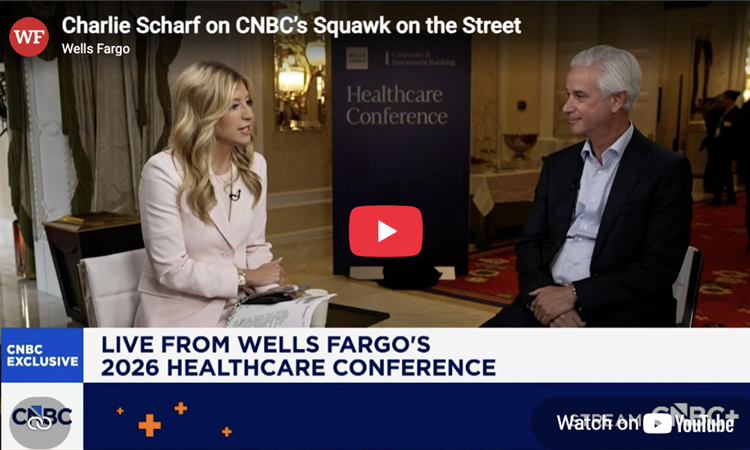
Wells Fargo Chairman & CEO Charlie Scharf joined CNBC’s Squawk on the Street for an interview from the 21st Annual Corporate & Investment Banking Healthcare Conference. During the interview, Charlie discussed Wells Fargo’s continued growth across business lines, the resilience of consumers and businesses, and why he remains optimistic about the economy.
Transcript
Sara Eisen: We’re here for the 21st year that Wells Fargo has hosted its annual health care conference. Joining me in Boston right now is Wells Fargo CEO Charlie Scharf. Thank you for having us.
Charlie Scharf: Thanks for being here, Sara. It’s great to be with you.
Sara Eisen: I know you’ve been doing this for a really long time, but it does feel like an exciting moment, at least when it comes to health care M&A. That’s been a big story for Wall Street — and a big story for you. Is that part of the play here?
Charlie Scharf: I think there’s no question about it. Health care is dynamic. There’s a huge amount going on, and we’re in the middle of a lot of it. This conference is a great example of it. We have over 300 companies and 850 investors, which is almost double what we had last year. They’re here because we get to convene these two groups to talk about all the changes that are going on.
Sara Eisen: What about dealmaking?
Charlie Scharf: Dealmaking is happening. There’s capital available, and there is a huge amount of evolution and change going on in the industry. You’ve got a lot of people having conversations about what’s next and what makes sense, so I would expect more of that to continue.
Sara Eisen: I was going to ask how sustainable is the wave of dealmaking that we’ve seen is, broadly beyond health care?
Charlie Scharf: Listen, there’s a huge amount of capital available. There’s a huge amount of change going on in the world broadly, and people are very active in the markets. They’re thinking that if they can get deals done in this administration, now is the time to get them done. Unless something happens in the markets to change liquidity or change spreads, I would assume that’s going to continue.
“Health care is dynamic. There’s a huge amount going on, and we’re in the middle of a lot of it.”
Sara Eisen: Where does Wells Fargo play? I know a big priority for you has been growing the investment bank, and there’s been some progress there. Where are you in terms of taking share, and how much more do you see to go?
Charlie Scharf: I think we’re in the beginning of what we view as our opportunity is, but we’ve made great progress. Our market share in the investment bank in the U.S. is 4.3%, up from 2.5% just a couple of years ago. We’re number six in announced M&A, up from number 14 a couple of years ago.
But we’ve got big aspirations because of the relationships that we have, and our opportunity to convene these groups of people, and our ability to participate more broadly in a value-oriented way for all of them. It’s a huge part of our future. We feel like we’re just getting going, but you’re seeing it in our results.
Sara Eisen: And you go up against the Goldmans, Morgan Stanleys, and JPMorgans.
Charlie Scharf: They’re great. There are a lot of great competitors out there — the traditional banks and the smaller institutions that focus just on these things. But what we have, we’ve got a balance sheet, we’ve got intelligence, we’ve got relationships. We lend to people and provide cash-management services. We’ve been banking a lot of these customers for decades and decades, and they like doing business with us. We intend to do more with them.
Sara Eisen: The lending is another key part of the story right now, and of the investor debate around your stock, which has been growing by double digits after the asset cap was lifted. I think some of the concerns were around the cost and the margin when it comes to competing, and whether you have to aggressively price these loans to grow the business.
Charlie Scharf: That’s not what we’re doing. What we’ve seen, coming out of an environment where you can’t grow, we had cut back significantly on our financing assets in the investment bank. Those are high-return but lower-margin. We basically added those back. That impacted our net interest margin, but we’re making more money and our returns are higher.
That’s moderating. That’s not going to be a big part of the story going forward. We’re not competing on price out there. We’re competing on our abilities, our relationships, and that’s what’s going to drive the higher returns that we see in our future.
Sara Eisen: What do you think is the most underappreciated upside potential for your earnings growth right now in the market?
Charlie Scharf: I don’t think it’s underappreciation. I think our investors want to see results, and it’s up to us to show that across all of our businesses we’re showing real growth. We’re starting to see that in every single one of our businesses, and we would expect to see it more consistently across every one of them.
Our return on tangible common equity when we started our journey was high single digits. We set a target of 15% and achieved that. We’ve said now 17% to 18%, and we feel very comfortable that we’re going to get there in a reasonable period of time. Then we’re going to raise it from there, because the natural mix of our business supports a higher number.
We feel really good, and we just want to show investors that this franchise is capable of delivering the things that we think it’s capable of.
“I think our investors want to see results, and it’s up to us to show that across all of our businesses we’re showing real growth. We’re starting to see that in every single one of our businesses, and we would expect to see it more consistently across every one of them.”
Sara Eisen: It’s also helpful that credit quality has been remarkably strong. Any change there?
Charlie Scharf: No. And it’s not just credit quality; it’s the overall health of our customer base — consumers and businesses. When we think about credit on the consumer side, delinquencies are actually improving from very healthy levels already. We don’t expect that to continue forever, but the health of the consumer from a credit perspective is really strong. They’re spending, their savings levels are sustainable.
One of the things we see, which is super interesting, is the idea of this K-shaped economy. That did exist. Which the more affluent customers were growing faster, while those with lower incomes were suffering somewhat. Then we saw a period where the affluent were continuing to grow and the lower end were stabilizing. Now they’re growing in tandem — still at a lower level, but you are seeing growth there.
It tells you that there’s broad-based strength out there, regardless of what you hear in some of the polls about how people are doing.
Sara Eisen: Is that surprising, given the inflationary pressure and higher gas prices?
Charlie Scharf: I think it comes down to people jobs and their wages growing. As long as those two things exist, yes, we should be concerned about inflation. Inflation is very, very real. But when people receive their paychecks, they see more money in their paycheck and have the ability to spend it.
That’s what we’re seeing in the results, and that’s contributing to broad-based growth among consumers. It also translates to what we see with small businesses, our commercial banking customers across the U.S., and large corporations.
Sara Eisen: I was also going to ask whether higher interest rates are ultimately going to put pressure on small businesses or those taking out loans.
Charlie Scharf: Probably not smaller businesses, because they don’t borrow long at those rates. We’ll see what happens with shorter-term rates. But again, what you see is that the underlying strength of their customer base is strong. As long as their customers are strong, they’ll continue to do fine.
Sara Eisen: You did just say that inflation is real. How big of a problem do you think we have on that front?
Charlie Scharf: There are a lot of reasons why we are where we are. It’s not particularly surprising. What’s most important is that there’s acknowledgment that it’s there and that it’s a hugely important focus of the administration, as well as in the way the Fed is thinking about things.
Tariffs are complicated. Higher oil prices are complicated. The argument that there’s a greater good here which we need to get through, I do believe, is fair.
Sara Eisen: When it comes to fighting Iran?
Charlie Scharf: I think the reasons why we’re fighting Iran — absolutely — and creating a fair and level trade environment across the world. Yes, it’s been disruptive in this period of time. But when you look at how we’ve been able to grow the economy, how we’ve been able to sustain employment and grow wages, that’s hugely relevant to our ability to get through this period and get to the other side.
Sara Eisen: So, you’re not against the tariffs?
Charlie Scharf: I am not against the idea of the tariffs at all. We could look at each one of the specifics and ask whether it’s all right, and I don’t think —
Sara Eisen: I don’t know. Canada is hot right now.
Charlie Scharf: Listen, what you have to look at — and by the way this is what we hear when we talk to our customers. When we go around and talk to our customers we talk about how you felt before tariffs and how you feel here. What they talk about is a fair and level playing field. It wasn’t a fair and level playing field.
We can politicize tariffs all we want, but they say, “We want the ability to sell our goods abroad the same way those companies can sell their goods here.” They don’t believe that was the case. They look beyond the shorter-term disruptions because they want to wind up in a better place relative to their ability to compete.
Sara Eisen: Because of all of this, do you think the Fed should be raising rates next week?
Charlie Scharf: I’m not going to prejudge what they should do. I find what Chairman Warsh says very refreshing.
Sara Eisen: I know you’re a fan.
Charlie Scharf: How can you not be?
Sara Eisen: Some people want information and guidance, and a little bit more about what would cause them to raise rates.
Charlie Scharf: I think he is spot on — not that it’s for me to judge. When you make the statement about things like dot plots and having lots of people talking about things, there’s no question that, whether it’s the media or whether it’s laziness that exists in parts of the investment community, people focusing less on the facts and more on those types of things that are either backward-looking or gossipy in nature.
His point is: Do the work. Look at the underlying facts. That’s what we’re going to do, and draw your conclusions based upon that. That’s what we want to have the ability to do. To put the Fed in a position because of things that are put out there that make it harder for them to tack an environment like this – I do think is not a great position to be in.
Creating flexibility and being clear that you’re going to make decisions based upon the data you see in real time. Even these conversations about what’s going to happen with rates two, three, or four months out — there’s a huge amount going on. I think the Fed should have the flexibility to make the decisions they’re going to make and explain why it made them.
Sara Eisen: What do you think about the administration’s — or the Treasury secretary’s — intervention in increasing the buyback, which we should get actually in the next hour, to try to calm yields?
Charlie Scharf: I saw that you did an interview with the secretary about whether it’s in line with what the Fed is doing. I think what you’re hearing from the administration is that they have a point of view on what they think will drive the risk premium over a period of time, and they’re willing to take action based upon that.
They feel very good about their ability to control inflation and create the kind of growth in a way where they don’t hurt each other, that actually help each other along the way. And they’re willing to take actions to show that.
Sara Eisen: You don’t have a problem with it?
Charlie Scharf: I don’t have a problem with that. Them being clear how they feel about things through their actions is reasonable.
Sara Eisen: Do you have a problem with the Clarity Act? The crypto lobby has come out with a campaign ahead of a procedural vote next week, and it says the big banks are against it.
Charlie Scharf: They is who?
Sara Eisen: The crypto lobby.
Charlie Scharf: They’re a lobby for crypto, so that’s not surprising. Just to be really clear, I’ll speak for myself. We would love to see a great Clarity bill, and we’re really close. But there are things about it which, if passed as is, I believe — and I think a lot of banks in this country believe, including the small banks which are incredibly important to this country — that if passed will create an environment that is unsafe.
Deposits are incredibly important for the banking system. They get recycled into loans, especially for small banks and communities. Protecting the deposit base is incredibly important, and that’s not what this bill currently does.
Sara Eisen: This is the issue about whether they can offer yields or rewards?
Charlie Scharf: No question. We’re fine with rewards, but not pulling deposits out of the banking system, especially small banks. They’re the ones who are most unhappy about the way the bill is currently written, not the larger banks.
The second issue is anti-money laundering. Regardless of what people say, when you look at the way things are written today, protections don’t exist across the crypto industry to provide the kinds of protections that the financial system that’s regulated currently provides.
If you fix those two things, absolutely, we’re supportive of it. We do want a bill passed, because to create the kind of environment where it’s clear what regulated institutions can do is incredibly important. That allows us and others to compete on a level playing field with crypto, which we’re all for. We want them to compete on a level playing field, and we want to compete on a level playing field.
Sara Eisen: Okay, got it. So, it’s not quite as nuanced as the banks lobbying against it.
Finally, Charlie, we were just having this conversation around AI. A big topic today is an Anthropic researcher that resigned and warned that everybody there thinks AI could kill us — that there’s a more than 10% chance at least. Do you have existential concerns about where we’re headed?
Charlie Scharf: I’m not an expert. I’m incredibly excited about AI, and I’ve got huge concerns about it. This is no different than other critical innovations that have happened, including in the health care space. We want people to create new things. We want people to create drugs. But to the extent that there are dangers, you should acknowledge them and make sure there are the right protections but allow the kind of innovation we need.
I heard what you said about China. I think we feel the same way as a country: We have to be at the forefront of this. But we should acknowledge that there are risks, not politicize it in terms of whether it’s a Republican or Democratic issue, and just ask what are the right ways are to create protections that allow large tech companies, large language model providers and companies like ourselves to use this amazing technology. It is an incredibly important and exciting part of our future.
Sara Eisen: Okay. Charlie Scharf, thank you very much. I know there’s going to be a lot more discussion around AI and health care today as well, which is one of the most promising and positive developments around AI. Thanks for having us here. We’ll see you later onstage.
That’s Charlie Scharf, the CEO of Wells Fargo.