July 22, 2026

16 min read
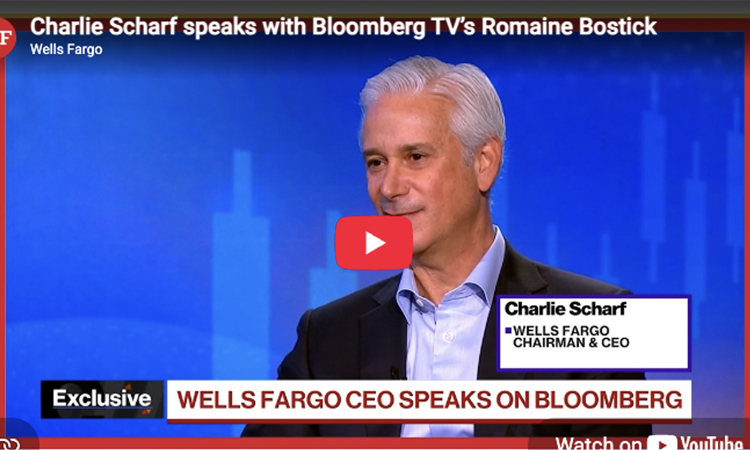
Charlie Scharf on Bloomberg TV with Romaine Bostick
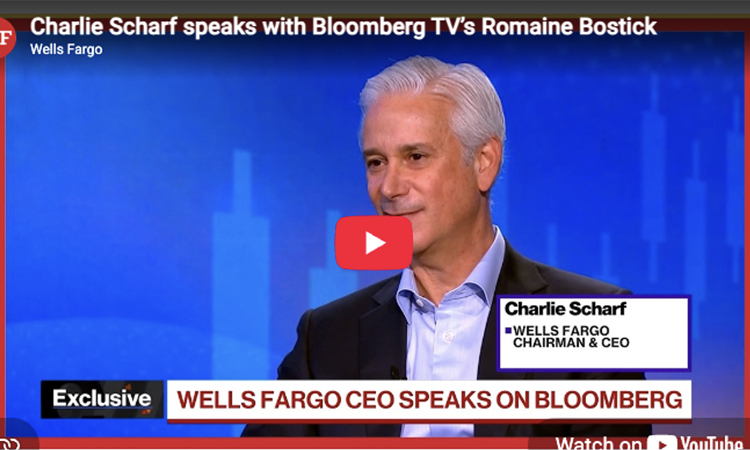
Wells Fargo Chairman & CEO Charlie Scharf joined Bloomberg TV’s Romaine Bostick for an interview on the resiliency of consumers and businesses, his plans for long-term, sustainable growth at the company, and being bullish on the U.S.
Transcript
Romaine Bostick: I’m here in our New York studio with the CEO of Wells Fargo, Charlie Scharf. Of course, the fourth largest U.S. bank out there, a bank that is now actually growing after roughly, what, six years or so of regulatory constraints. You’ve been there for more than six years, navigating through those constraints. I think a lot of people have seen the fix that you’ve done over that time, and now the big question is, what do the next six years look like? Is that a growth story?
Charlie Scharf: It certainly is for us. We’re incredibly proud of the progress that we’ve made. We’re a very different company than we were when I got to the company. I guess it’ll be seven years in November. And what you’ve seen since the asset cap has come off is that we’re able to compete on a level playing field with everyone, and we’re growing our consumer bank, we’re growing our commercial bank, we’re growing the wealth business, we’re growing our corporate investment bank. And we’re doing it in a way which is very, very highly focused on sustainable growth and higher returns. And we think we’ve got huge opportunity in front of us.
Romaine Bostick: When you say sustainable growth, some investors want to see aggressive growth. Can you be aggressive and be disciplined and sustainable?
Charlie Scharf: Listen, in this business, you’ve got to be very, very careful about what aggressive means. And we also have to be very, very careful about distinguishing between what the markets are adding to our performance, or any other financial services provider’s performance, and what we’re doing. We’re not looking for quick wins. We’re not looking to take outsize risks in the short-term to drive stronger results. We’re looking at building the underlying franchise, building customer relationships, building flow of things that will go up and down based upon how the markets are doing. But that’s what I mean when I say sustainable over a period of time.
Romaine Bostick: Well, I’ll talk about this transition then, because over the past few years, people will look at what you’ve done over the last few years and call that a turnaround story. Although, we should point out, Wells was in relatively good shape even when that asset cap was placed back in 2018. Was that a turnaround story, or was that just kind of regulatory rehab?
Charlie Scharf: Well, I think you’re right. It’s not a turnaround story. The company was always very strong. We always had a great franchise, but we had to fix things that needed to get fixed inside the company. But from our customer standpoint, we were serving them every day. We were making loans, we were taking deposits. We were constrained on growth, but we were there providing what we did day in and day out. And financially, we were still doing okay.
And when we looked at what we were able to deliver, we were not able to grow our balance sheet. We’ve been focused a lot on efficiency inside the company. We’ve been focused a lot on growing our fees inside the business. So our corporate investment bank has grown very nicely. Our credit card business and credit card spend is growing very, very nicely, focused on building treasury services.
And now we can grow the balance sheet so we can more holistically serve customers. And that’s what you see when you look at the results of this past quarter, with earnings per share of 25%, revenue growth double digits, growth across every one of our businesses in terms of revenue. We’re certainly in a different place. And our goal is to be viewed as the best financial services provider in these businesses in the country.
Romaine Bostick: How much of that is because of Charlie Scharf and the executive team, and how much of that is because of market conditions and economic conditions?
Charlie Scharf: Well, I think it’s predominantly because of the quality of the franchise and the broad group of people that work at the company. Listen, what I and the new management team have been able to do is get people focused, create a different set of priorities, but a lot of people execute day in and day out.
And the fact is, the markets do help. So there’s no question that these times are really good for banks. And so if you’re not doing really well as a bank today, there’s something not quite right with either how you’re executing or what your strategy is. And that’s not lost on us.
But again, we look at the underlying metrics of each business. Are we growing our consumer checking accounts? We’re growing commercial banking customers. We’re growing the kinds of loans that we want to grow. We’re taking the risks that we want to take that we think will provide strong returns over cycles, and not get over our skis, and not pretend that it’s all us. Some of it is the markets, for sure.
“Our goal is to be viewed as the best financial services provider in these businesses in the country.”
Romaine Bostick: You just reported earnings, and the number that, I think, jumped out for a lot of folks was the growth in the investment banking business. You’ve been on a hiring spree there. Does that continue, that buildout?
Charlie Scharf: Yeah, so we’ve been on, I’ll call it, a disciplined path to growth in our corporate investment bank. We’re a huge lender to corporates of all sizes in this country, large corporates down to middle market companies. We provide treasury services, and what we’re doing is building on those relationships with a stronger set of products and services, coverage groups, M&A underwriting capabilities.
And so we’ve been very disciplined about adding resources in a sequential way, seeing that they’re paying off, and we’re seeing the results. And so, yeah, we can expect that to continue as we move towards our ambition of being top five.
Romaine Bostick: The ambition of being top five, I am curious. You and your executive team are based here in New York. Obviously, the bank is headquartered in San Francisco. Your larger employee base is down in North Carolina and Charlotte, I believe. As you build out an investment banking business, can you do that in Charlotte, San Francisco, or is that a New York story?
Charlie Scharf: It’s a combination of all of the above. We do have more resources in New York than we used to have, for sure. But as you point out, we have more people in North Carolina, and in Charlotte, than any other specific location, and that goes back to the merger of Wachovia and Wells Fargo.
Half of our corporate investment bank is down in Charlotte, and the other half is here. We also, I should say, do have offices around the country and other parts of the world. And so we would expect to see growth in both locations and closer to serving customers across the country.
Romaine Bostick: How committed is Wells Fargo to its footprint here in New York City?
Charlie Scharf: Listen, we have, I think, between 4,000 and 5,000 in New York. That number, at this point, will probably, in total, stay roughly what it is. And the question for us is going to be, where’s the best talent? Where do they want to live? Where do they find the most attractive place for them to want to live and do business?
It’s very hard for us to get people to move from North Carolina to New York, even when we try. Sometimes it’s hard to get people to move from New York down there. There are people that self-select, and over a period of time, how New York does and how North Carolina does and how California does, does matter to where people want to live, and that’ll be an important driver.
Romaine Bostick: I am curious about that, though. At your bank, and basically with all the different business lines, you have a very keen insight into the economy across all the geographies here. When you look at sort of the rebound that we’ve seen post-pandemic, whether it’s in New York or even some of the down South and some of those markets here, what are you actually hearing from your clients, the people that you’re talking to, about where they’re doing business? And more importantly, are they comfortable right now being able to do business?
Charlie Scharf: So, I would say what you hear from them and what they’re doing aren’t the same thing. People are nervous. They read the newspapers, they watch TV, they see what’s going on in other parts of the world. They’re concerned about AI. And so those are things that are very much on their mind. But when you look at what they’re doing, when you look at consumers, they’re spending more year over year. Their delinquencies are down, they’re saving more. They’re doing really, really well.
When you talk to smaller companies across the country, again, they’re nervous, they’re concerned about how they should be planning for the future. But they’re in really great financial condition.
Romaine Bostick: Are you surprised by that? Given how persistent inflation has been, and just over the last three weeks, you’ve seen oil prices spike back up 30%, gasoline prices $4 a gallon, mortgage rates 6.5%. So does it surprise you to see that economic resiliency?
Charlie Scharf: Yes and no. I think if you would have laid those things out, you would have said, well, would you have as strong an environment today? You would say probably not. But the fact is, employment is still strong. Wages, at least for our clients, are growing faster than inflation, and that’s going to be the most important driver of how the consumer performs. Now, that’s not to say that that’s going to last forever, but we do continue to see that. And so that’s what’s going to drive the results.
Romaine Bostick: Well, as you sort of continue this growth story for Wells Fargo, do you feel like the economic conditions will be as supportive as they have been over the last couple of years?
Charlie Scharf: So, I’d separate into what I know versus what we would guess. What we know is that the strength continues. When we look at the stats day in and day out, the strength of the consumer, the strength of businesses, hasn’t changed from what we reported just a couple of weeks ago.
Are we nervous about what the future holds? Sure. The fact is, things are really, really good. Markets are really strong. There’s certainly volatility, but things are priced quite well in the credit markets and in the equity markets. There’s a huge amount of liquidity out there. There’s a huge amount of financing taking place.
And at some point, that doesn’t go on forever. So we’re trying to be very thoughtful about recognizing that good times don’t last forever. But things don’t look like they’re breaking quite yet.
Romaine Bostick: Is your expansion or the growth in this business going to be primarily in the U.S.? There’s been talk that you may be looking to expand some of your investment banking business over in Europe.
Charlie Scharf: Ninety-five percent of our revenue comes from the U.S. We’re thrilled about that. So goes the U.S., so goes us, and we’re big-time bullish on the U.S. And so we’re going to continue to invest in all of our businesses here in the U.S. and believe that there’s significant opportunities for us to grow with the economy and to take share.
The business that you mentioned, the investment bank, does have to grow outside the U.S. For us to serve large companies and middle market companies, they want to expand outside the U.S. properly. We need to have a presence, we need to have distribution capabilities, we need to have advisory capabilities. But it’s there primarily to serve the customers that we do business with here in the U.S.
Romaine Bostick: With regards to the private markets and your role at Wells Fargo, you’ve obviously been involved in some deals. I believe you were an advisor on Apollo’s deal for that Broadcom AI center and a couple others here. You don’t see any real credit concerns, in terms of credit quality concerns, in that space?
Charlie Scharf: Well, in the private markets, we always say this: private markets are a very, very broad group of people. There are some that do it really, really well, that have the experience, that have been through cycles, that have the analytics, that have the rigor. Those are the ones that we try and do business with, and those are the ones that we focus our attention on, and we feel really good about the credit support that we’re providing for them.
There are others out there that potentially should be more concerned about, but we don’t have broad exposure to that. But when we see certain transactions, there are those that are willing to take a lot more risk than others that do seem to have different levels of discipline and different levels of analytics.
So, if credit does turn down, it’s just like in the banking universe. Some do it really well, others do it less well. Some will do quite well. We believe those are the ones that we bank, others not as well. And that’ll be shown up away from us.
“Ninety-five percent of our revenue comes from the U.S. We are thrilled about that.”
Romaine Bostick: But the structure of some of these AI data center financing deals — is Wells Fargo still interested in doing more?
Charlie Scharf: We are. Listen, the fact is, this is a necessary build that needs to take place to support what AI can do. But here, too, just like we talked about private credit, not every transaction is the same, not every piece of risk is the same. Who you finance, who the guarantor is, who’s got the revenue model to support — it really does matter. And so we very much are in active dialogue, not just with the things that we’ve done in the past, but the things that we want to do in the future. But you’ve got to be selective about who you’re financing and what the structures are.
Romaine Bostick: Your board recently reorganized your compensation to effectively structure it to keep you around for, what, another six years, basically through 2031. There’s been a lot of talk as to whether you will be there through 2031 or whether you would have ambitions, maybe, to take the seat of another CEO job.
Charlie Scharf: I have no ambition to do anything other than stay at Wells Fargo, build Wells Fargo, and retire from Wells Fargo. That’s what I intend to do, and that’s what I’m going to do.
By the way, I think it’s a great seat. I mean, when you look at, if someone could give you the opportunity to run a company like Wells Fargo, with the quality of the business that’s been so constrained for so long, that has picked and chosen the businesses to be in. We have amazing opportunities to continue to do a better job for our clients, to grow and increase returns. And I think we can make a difference in this country, and that’s incredibly appealing.
Romaine Bostick: Do you ever look at your old employers and get envious, BNY, JPMorgan, the others?
Charlie Scharf: No, I don’t get envious. I look at them and you can learn a lot from people. A lot of companies out there do really, really well. They’ve done really well. And hopefully, over time, they’ll look at us and feel the same way.
Romaine Bostick: Do you ever talk to Jamie Dimon?
Charlie Scharf: I talk to Jamie. I talk to all the other leaders in the business. There are things we’ve got common interests on, and we talk about those things, but we compete hard day in and day out.
Romaine Bostick: I do have to ask you about the Wall Street Journal story from the other day that alleged that the head of the IRS and the Social Security Administration, who used to work at JPMorgan, allegedly spied on some of his rivals within the organization, including you, when you were running the commercial business there at JPMorgan. Is there any truth to that? Were you aware of anything potentially going on?
Charlie Scharf: I have no idea. Frank and I have known each other for, I think, maybe 30, 35 years. He spoke to me the other night, and he says it’s not true. By the way, I don’t know what I would have that anyone would have any interest in. And so I honestly don’t think about it that much.
Romaine Bostick: All right, Charlie, a final question here, and this is really about the next six years. When that next six years is wrapped up, whether you’re there past 2031 or beyond, what exactly do you want to make sure gets done over the next six years?
Charlie Scharf: I think we’ve got the opportunity not just to have Wells be a better-performing company, but be back to what we should be, which is the best-performing financial institution in this country, which means real sustainable growth with the highest returns adjusted for our business mix. And ultimately, that should drive us to be the most respected bank in this country. We compete with great people out there, so it’s not going to be easy to do, but that’s our goal.
Romaine Bostick: All right, Charlie, really appreciate you doing the interview.
Charlie Scharf: Thanks.