January 22, 2026

8 min read
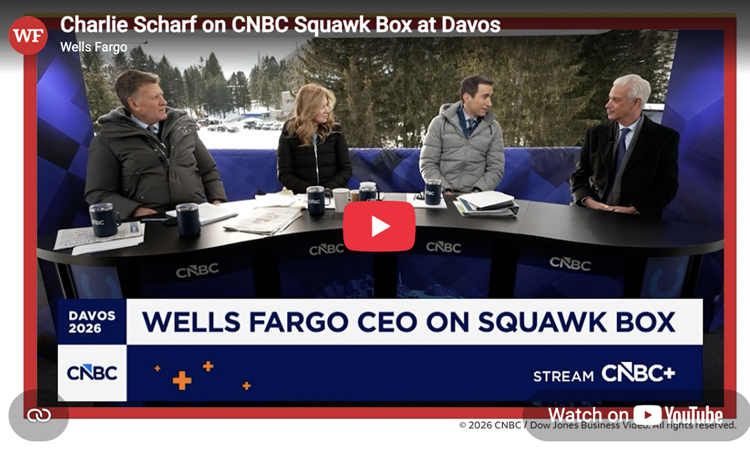
Charlie Scharf on CNBC Squawk Box at Davos
Wells Fargo Chairman & CEO Charlie Scharf joined CNBC’s Andrew Ross Sorkin, Becky Quick, and Joe Kernen for a Squawk Box interview from the World Economic Forum in Davos. Charlie discussed Wells Fargo’s company-wide transformation and growth plans, aspirations in Corporate & Investment Banking, and current industry topics.
Transcript
Andrew Ross Sorkin: Joining us right now from Davos for the first time is Charlie Scharf. He’s the CEO of Wells Fargo. Good morning.
Charlie Scharf: Good morning. How are you doing?
Andrew Ross Sorkin: Do you want to react to that? I’m curious what you think about interest rates, the Fed, and maybe even who you might want to be the next Fed chair. How much do you care?
Charlie Scharf: I care a lot, but I’m thrilled with the choices on the table. I think they’re all great choices. We have a process to get from here to there, and I think we’re in a really good place.
Andrew Ross Sorkin: What do you think about interest rates right now and this growth trajectory?
Charlie Scharf: Listen, first of all, the growth trajectory — everything that we see — is really, really good. It’s more likely than not that growth will be stronger than people expect. And for us, as a U.S. company with so much of our business in the U.S., we feel great about it. Rates? We can debate . They likely will go lower, and that’s probably a good thing for a period of time. How low they go I think is dependent on the data that we see. But I think that would be a good place to be, and markets would certainly feel good about it.
Andrew Ross Sorkin: Okay. The other big issue — credit cards. You’re in the credit card business.
Charlie Scharf: I like the credit card business.
Andrew Ross Sorkin: You like the credit card business?
Charlie Scharf: Yes, I do. I have one.
Andrew Ross Sorkin: I assume you’d like it a little less if interest rates were capped at 10% across the board?
Charlie Scharf: First, remember the president hasn’t suggested rates get capped forever across the board. As we think about the business, it’s a great business, an important business, and it will continue to be. We offer products that are well below 10% for an extended period of time. I think we need to be focused on what we’re trying to solve. And what we don’t want to do is put in artificial price controls that could be harmful at a period of time where it matters most to Americans.
Andrew Ross Sorkin: Jamie Dimon has said publicly he thinks this is dangerous. How dangerous do you think it is? What would the real ramifications be, even if it was just for a year?
Charlie Scharf: I’m not sure what this is — I think we’ll see. One thing I’ve learned watching the administration: they have lots of ideas, they’re very focused on the outcomes, and the president is very focused on affordability. And the thing about this administration that I think is wonderful is that they engage and they want to get to the right answer, they want to do the work, they want to do the study. Ten percent everyone overall I think would be a real problem.
Andrew Ross Sorkin: Do you think it would meaningfully reduce credit availability? Are there a lot of people out there who need that credit? They put out a press release saying, “capping at 10%,” but maybe that’s a different demographic.
Charlie Scharf: I didn’t see the press release. My guess is it was “capped at 10% for a year,” which is what the president asked for, which is what they’d do anyways because of intro promotions. My guess is that’s pretty good marketing.
Andrew Ross Sorkin: Pretty good marketing. One of the other big questions is housing. The president has talked about going after large homebuyers — companies like Blackstone and other publicly traded firms — saying we can’t have them buying up homes and pushing prices higher. There’s also chatter about potentially allowing Americans to use their 401(k)s for down payments. What do you think of that as a mortgage originator?
Charlie Scharf: I don’t really know enough about the issue of corporations vs. individuals. I do think one of the things that has come out, anytime there’s an inconsistency — whether it’s between individuals and institutions — where one person is advantaged, that’s not a good place to be. We shouldn’t have a policy where it’s more affordable for an institution to buy something than an individual. That doesn’t make sense and doesn’t get to the right goal that we want. But I don’t understand the full extent of that.
Becky Quick: Charlie, I want to congratulate you on where Wells Fargo is, and the turnaround that has taken place on your watch. The markets have noticed. What are your plans from this point?
“One of the most thrilling things is to see people inside the company feeling great and being in the marketplace and feeling like they can compete again.”
Charlie Scharf: First of all, thank you. As I’ve said, it’s tens and tens of thousands of people doing the work, and I’m appreciative to all of them. We’re able to compete on a level playing field now for the first time since 2018. And so, when you look at our results, we actually feel great, not just about the fact that we’ve put these issues behind us, but that almost all of our businesses are growing today. And we were able to do that while not being able to grow loans, grow deposits, grow inventory and things like that. And so now we’re able to do all that.
Becky Quick: The shackles came off.
Charlie Scharf: Exactly. The market didn’t give us any degree of reprieve. They had the same high expectations for us. And so, our balance sheet is up 11% since the asset cap was lifted. We’re going out to companies who we had to ask to take deposits away to say, please bring them back. We’re increasing our inventories and financing. We’re growing loans again. And so, you know, we’re still very, very conscious of being, you know, what Wells Fargo is. Thinking about our own risk tolerance in the same way but being much more on our front foot. And I’ll tell you, one of the most thrilling things is to see people inside the company feeling great and being in the marketplace and feeling like they can compete again.
Andrew Ross Sorkin: I want to go back to the housing for just one second. The 401(k) piece, have a thought on that?
Charlie Scharf: I think it’s super interesting. Under the right circumstances, depends on the amount. I would think about level of concentration within 401(k) and things like that. It should be a long-term investment locked up in a long-term plan. The devil’s in the details but I think it’s really interesting.
Andrew Ross Sorkin: Your investment bank has had a lot of success lately. People don’t always think of Wells Fargo in that context. Kudos to Doug Braunstein and others. What does that look like five years from now?
Charlie Scharf: The investment bank is one of the great opportunities that we have. It’s one of the great businesses that we currently have. Doug has done a great job. Fernando Rivas runs the business. Tim O’Hara has done a great job in terms of bringing talent on. We’ve always been in the business, but we’ve always wanted to be below the radar screen. It’s a natural progression from using your own balance sheet to finance companies to give them access to public markets, give them access to broader degrees of private credit, provide financing advice. And so, you know, we’ve made the decision that we don’t want to keep it under the radar screen. We want to grow the business. We want to continue to serve companies of all sizes. We have competitive advantages. We have treasury services relationships, we lend a huge amount of money to these companies. I think they like doing business with us and have liked doing business with us for a long term. And they want more options, and there aren’t a lot of companies out there that can do the types of things that we did recently for Netflix, with the size bridge loan that we made, or what we did for Quikrete in the non-investment grade market. So, this is a journey. I always say the world is littered with companies that have tried to do this and failed. They’ve failed because they’ve hired the wrong people. They’ve done the business that no one else wants to do. They’ve compromised; they’ve taken too much risk. And so, we’re trying to be very, very thoughtful about growing this at the right pace. And we hope it becomes a bigger part of the company and we’re quite confident that it will be profitable with high returns.
“The investment bank is one of the great opportunities that we have.”
Andrew Ross Sorkin: Charlie Scharf, thank you, sir.
Charlie Scharf: Thanks for having me. Great to see you.