
August 26, 2026

4 min read
The journey of Irys Technologies mirrors San Antonio’s rise as a cybersecurity hub
From an award-winning civic engagement app to cybersecurity and AI security solutions, Irys has evolved alongside one of the nation's fastest-growing cyber ecosystems.

Key takeaways
- Founded in 2017, Irys Technologies evolved from a civic technology company to a cybersecurity one.
- Continuously adapting to new challenges aided Irys in its year-over-year growth
- A strong relationship with Wells Fargo Commercial Banking helped Irys scale its businesses while supporting new opportunities.
Decades from now, you won’t be able to tell the story of San Antonio without mentioning its cybersecurity boom in the 2010s and 2020s.
Traditionally known as “Military City USA” because of Joint Base San Antonio, the city was well-positioned to capitalize on growing demand for cybersecurity expertise, building on decades of military-driven innovation and national defense leadership.
It’s the No. 2 cybersecurity hub in the United States, second only to Washington, D.C., with an estimated total cyber workforce of more than 26,000.

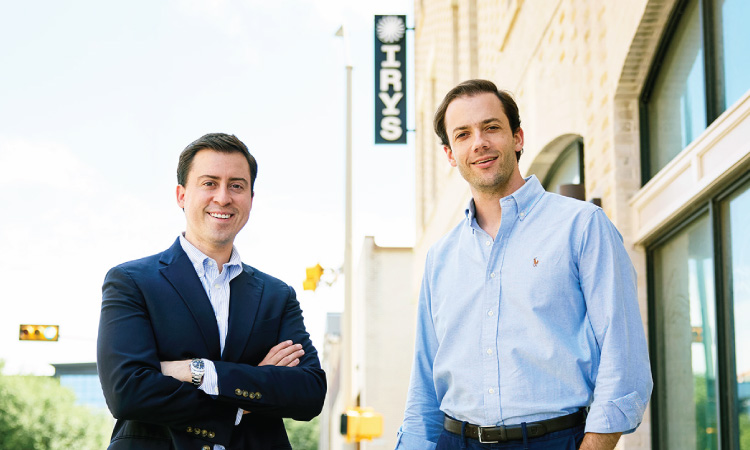
Irys Technologies co-founders Eduardo Bravo (foreground) and Beto Altamirano collaborate at the company's office.
Irys Technologies, founded in 2017 by Beto Altamirano, Eduardo Bravo, and Alberto Gomez, hopes you won’t be able to tell the story of San Antonio’s cybersecurity boom without mentioning the company.
But Irys didn’t start as a cybersecurity firm. It began as Cityflag, Inc., an entrepreneurial venture focused on civic technology and community engagement. The trio’s first major project was modernizing San Antonio’s 311 digital platform, leading to the launch of the 311SA app in 2018. It gave residents the ability to file municipal service requests via smartphone.
“Our thesis was that our mobile application was going to create an engagement boost for users because of its social element and gamification,” said Altamirano.
In 2019, 311SA won a Smart 50 award for “community engagement.” Solving civic challenges taught the founders how technology could improve decision-making, automate complex processes, and engage users at a large scale. It also pointed them toward a larger opportunity: Irys.
Irys is an easy-to-use, secure system that helps leaders make quicker decisions in response to cybersecurity issues while staying ahead of emerging threats. It connects old and new systems, so everything works as one without having to replace existing technology.

“A part of the reason we picked Wells Fargo was because we had an ability to grow with it. They have some kind of product or service for everything our business needs.”
As demand for the platform grew, so did the company’s ambitions. To support that growth and its expanding portfolio of government and military contracts, Irys turned to Wells Fargo.
“They’re our bank,” Altamirano said. “They started with us in the beginning and have excelled and been proactive. A part of the reason we picked Wells Fargo was because we had an ability to grow with it. They have some kind of product or service for everything our business needs.”
In this case, growing meant acquiring a local San Antonio firm, increasing its number of employees sixfold. That growth gave Irys’ leaders a clearer view of the industry’s next frontier. Just as Cityflag evolved from civic engagement to cybersecurity, the company’s next chapter emerged from the changing needs of its customers.
Working closely with officials in heavily regulated industries such as pharmaceuticals, health care, government, and military, Irys’ leaders saw firsthand how organizations were struggling to implement AI safely.
“The traditional security tools we all knew and grew up with weren’t built for systems that process enormous volumes of prompts, automated responses, and AI-generated code,” said Altamirano. “And for customers handling sensitive information, sending data to a third-party cloud for review simply wasn’t acceptable.”
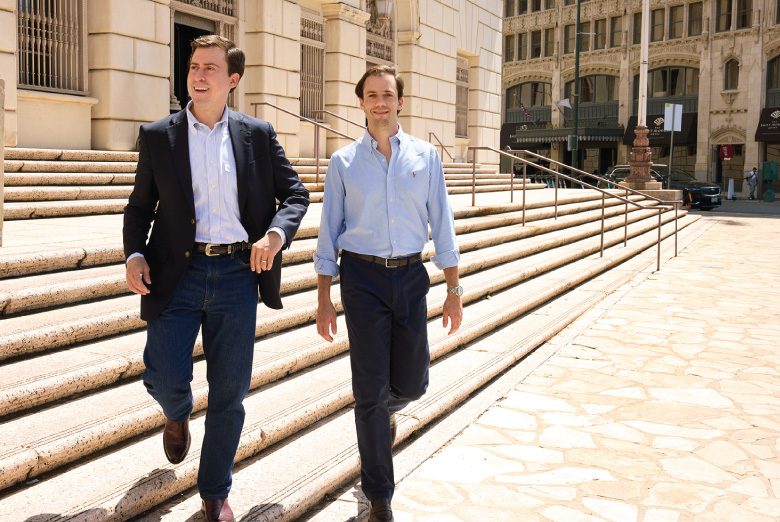
Irys Technologies co-founders Beto Altamirano (left) and Eduardo Bravo walk through downtown San Antonio.
That’s how Lucien, a company spun from Irys by Altamirano, Bravo, and Gomez, was born.
“It’s hardware first and foremost,” said Altamirano. “It’s on-site and doesn’t need the cloud. Lucien reviews prompts being submitted to AI and LLMs and then studies the responses. It flags, blocks, or redacts content that violates rules set by the company. AI fraud is set to be a multibillion-dollar issue in the coming years, and Lucien helps solve for that.”
As San Antonio’s cybersecurity sector continues to expand, Altamirano hopes that, in the next few years, Irys will continue to grow and Lucien will become widely adopted. One thing he knows isn’t likely to change is the company’s relationship with Wells Fargo.
“They’ve excelled in being proactive with us, in helping us connect the dots,” he said. “Whether it’s engaging in real conversations or saying our names in rooms at events in Austin, Texas, or Washington, D.C. That’s a powerful thing for us, a mid-stage company, and it helps us gain momentum for the future. I couldn’t be happier with our relationship with Wells Fargo.”