
April 22, 2026

8 min read
The secret to business success? A strong plan. Here’s how to write one.
Having a business plan means entrepreneurs have a strategy to grow. At HOPE Inside centers in Wells Fargo branches, small business coaches are helping aspiring and existing business owners achieve their goals.


Key takeaways
- Free small business coaching: Operation HOPE coaches are helping entrepreneurs at HOPE Inside Centers within select Wells Fargo branches across the U.S. by offering free financial coaching.
- Tangible results: Many business owners work with their coach to craft and maintain a business plan, among other essentials to managing and growing a business.
- Grow your business: By writing a business plan, business owners create strategies to help their business grow and address challenges, boosting their chance of success.
- Find your coach: Start or level up your small business journey by connecting with an Operation HOPE small business coach
India Callahan-Igbokidi’s dream of becoming a fashion designer involved a lifelong path from sketchpad doodles, to merchandising school, and, eventually, a small business.
But like many entrepreneurs driven by a passion, her biggest challenge is getting funding to make that dream possible. That is when Raymond Haines, a HOPE Inside Small Business financial coach, helped Callahan-Igbokidi draft a business plan.
“Fashion has been that thing that bridges the gap between my love for art and giving people the opportunity to wear whatever it is they want to stand for proudly,” she said. “If I can dress the next generation of changemakers, that is what I’m set out to do.”
A business plan is a rite of passage for any entrepreneur, Haines said. But few are taught how to write one or where to even begin.
That’s one reason why small business coaching has come to several HOPE Inside centers within select Wells Fargo branches around the country, though coaches take on clients nationwide.
This work builds on Wells Fargo’s collaboration with Operation HOPE, where financial experts in select Wells Fargo branches provide free, one-on-one coaching to help people with growing savings, reducing debt, and boosting their credit scores. And they don’t have to bank with Wells Fargo to get support.
The goal for these small business coaches is to make managing a business more attainable. With Callahan-Igbokidi, Haines made writing the business plan more digestible. Now that she has a plan, her next step is competing in a pitch contest, which will help Callahan-Igbokidi attract funds to grow her futuristic streetwear clothing brand I S Cal.
“I now have a tangible tool that helps convey the direction of my business to potential investors and partners,” she said.
“I have unfortunately seen many talented people not have access to resources that can help them expand and grow. I want to be part of that change, and that’s what Operation HOPE and Wells Fargo does.”
[Video overview: India Callahan-Igbokidi, owner of I S Cal Apparel; Raymond Haines, an Operation HOPE small business coach; and Shatoya Wallace, Wells Fargo branch manager talk about support provided by HOPE Inside centers.]
[MUSIC]
[India Callahan-Igbokidi, Owner, I S Cal Apparel, LLC]
Since I was a kid, all I’ve ever focused on was art.
Eventually I started drawing clothes and shoes, and that just opened up a door of opportunity and imagination for me.
[Raymond Haines, HOPE Inside Coach, Operation HOPE]
Operation HOPE small business coaches empower the community by helping entrepreneurs create business plans, strategize their futures, and also developing new ideas.
[Shatoya Wallace, Branch Manager, Wells Fargo]
Customers are appreciative of Wells Fargo’s investment in financial education through HOPE Inside.
They aren’t learning this in schools. They aren’t having these conversations in their households.
We’re able to help them by having these conversations in person, understand what’s on their mind, and how we can help.
[Callahan-Igbokidi]
I S CAL stands for imaginative souls curious about life. It’s an abbreviation of my name.
So my full name India Simone Callahan. But it’s also made to represent basically the weird, the different, those who stand out.
We create streetwear. We have our basic casual streetwear and our luxury streetwear pieces.
We also have accessories that we’re building on and trying to expand.
[Haines]
When India came to me, it was important for us to create strategy, to work on her e-commerce, to have brand development conversations, and then also to have conversations about access to funding.
[Callahan-Igbokidi]
Raymond has been able to help me with really streamlining and focusing my ideas.
He’s also helped me build out a beautiful business plan that I can utilize to get funding for my business, which has been our biggest barrier over the past eight years since we’ve actually opened.
He’s also helped me network and connect with other people, which has been really, really great.
[Haines]
People hear Wells Fargo, and they know that this is a reputable bank that’s available across the country.
And I think that having us as small business experts inside of the Wells Fargo offices is an additional resource that Wells Fargo is providing to the community.
[Wallace]
Customers are really excited about the knowledge that they’re getting, things that they didn’t know coming from a professional that has their best interest in mind and at heart.
[Callahan-Igbokidi]
I believe the future holds I S CAL being the staple print for futuristic fashion.
Just really giving us the opportunity to spread our wings, basically becoming a household name.
[Haines]
All I see for India is expansion, having her be a staple of the community. I think that that’s kind of where it’s headed right now.
[Callahan-Igbokidi]
That’s why I wanted to build my business, just to not only create generational wealth for myself and for my family, but for the next generation.
[On-screen text]
© 2025 Wells Fargo Bank, N.A. All rights reserved.
Watch: Raymond Haines, an Operation HOPE small business coach based in Los Angeles, helps entrepreneurs at Wells Fargo HOPE Inside branches (2:44).
Credit: Hector Batista
Breaking down barriers to wealth-building businesses
Residents are no strangers to side hustles or business ventures near the Los Angeles branch where Haines is based.
“In the Baldwin Hills community, there are a lot of up-and-coming entrepreneurs who are trying to understand how to gain access to capital to start their businesses,” said Mario Holten, vice president of Philanthropy and Community Impact for the local Los Angeles community, and who previously managed the neighborhood’s Wells Fargo branch.
While bankers like Holten are experts at helping customers with everyday banking, he said, having a coach like Haines within the branch’s HOPE Inside Center means they can help these aspiring entrepreneurs. He’s already seen success stories. Operation HOPE’s coaching helps people with challenges like getting business loans, developing sales or growth strategies, or navigating supply chain or technology hurdles.
“Naturally, they aren’t learning this in schools. They aren’t having these conversations in their households. We’re able to help them by having these conversations with them in person and understanding what’s on their mind and how we can help,” he said.
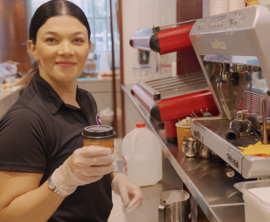
Monica Carlos also sees these cultural barriers to discussing personal finances in her community of Chula Vista, California, outside of San Diego and just a short distance from the Mexican border. For example, money can be a taboo topic of conversation in the Hispanic community, she said.
“I think the beauty of working with this community is actually seeing them understand the importance of [managing their money], creating that desire for them to stay in the program, and actually start seeing the progress,” she said.
On top of learning business planning, many of her small business clients need help managing their personal finances, too. Their business is how they pay themselves and take care of their families, so business and personal finances need to be managed in tandem. Carlos draws from her own experience as a business owner to help them navigate these challenges.
“Working with them on credit and money management is also near to my heart because I ran into that problem,” she said.
Why you should write a business plan
Are you an aspiring entrepreneur? If you, too, have dreams of starting or growing your own business, a business plan is key for a few reasons.
A business plan could boost your chance of success
As Haines says, “The most successful businesses are the ones that are the most organized.”
By writing a business plan, you’ll have to answer important questions like what your product or service is, how it can outcompete others, and who your target customers are. If you don’t have an answer, you can research, ask others for guidance, and improve your plan.
The result may be that your idea can’t work in its current form, but your chances of success may be higher with some changes. Even in a worst-case scenario, a business plan could save you from risking time and money in an under-developed enterprise.
“A business plan is where all the gaps come out,” Haines said. “That’s where they start to show.”
A business plan will help you attract supporters
While an elevator pitch can be your step in the door, a business plan is critical for selling a complete vision of your business to others and addressing their concerns. It may even be necessary if you’re interested in applying for a loan or line of credit or seeking a government or foundation grant.
“Access to cash is a goal for many businesses, and a business plan is not only a requirement for most grants, it also helps [prospective] funders understand what a business does and, most importantly, how it will succeed,” Haines said.
Prospective investors and loan officers will want to dive deep into your business’s financials. Either as part of or in addition to your business plan, preparing a balance sheet and projecting cash flow will be important.
A business plan will help you craft a strategy for growth
Aspiring entrepreneurs may be laser-focused on bringing their passion to life, but that’s only the beginning of a business’s lifecycle.
Typically, a business will need to grow to sustain itself or live up to its founder’s plan. A business plan shows how and where opportunities lie. That growth strategy may involve how the business can enter new markets or locations, launch advertising campaigns, or develop new products and services.
“A business plan is for business owners who want to take their business to the next phase,” Haines said.
How to write a business plan
If you’d like to create a business plan, first try breaking it down into small parts. Here’s a step-by-step guide to do just that.
The critical pieces of a business plan include: a summary of the business and its history or mission, a description of the product and/or service, an analysis of the market and competitors, a plan for marketing or promotion, an organizational chart or description of leadership, a breakdown of its current and projected finances, and any future plans or trends.
Here are a few tips:
Your business plan should be as unique as the business
A business plan should complement the look and feel of the business, Haines said. If your idea or brand is dependent on a certain consumer experience, try to infuse it into your plan.
Callahan-Igbokidi’s brand for I S CAL is futuristic. In fact, online shoppers can explore a collection of clothing and jewelry by visiting planets in a 3D environment. Her plan explores how the products, their message, and the brand are connected.
“My business is very visual in nature and requires images and photos to tell the full story and convey what I S Cal is about,” she said.
Your business plan should address potential hurdles head-on
If drafting a business plan sounds scary or uncomfortable, it may be because you are concerned about uncovering or confronting challenges or weaknesses. Haines calls this a “fear of the transparency.”
By creating a business plan, you can name and address any fears you or other stakeholders have. Your plan can even include what you or other leaders of the business will do when you navigate financial, operational, or other issues.
“I always refer back to the business plan because if there’s a concern with the organization — maybe there’s a lot of employee turnover, [for example] — there’s a section in the business plan to address that,” Haines said.
Your business and business plan should evolve in tandem
While it can be comforting to think you’ve completed a business plan, it should be a living document that changes over time as your industry, product, or business goals change. One idea might be to put a regular — quarterly or annually, for example — meeting or reminder on your calendar to address any edits you or your team need to make.
It is important to keep your plan up to date, but that doesn’t mean you should deviate from it. Try focusing on areas that have the biggest potential impact on your business, Haines said, such as changes in your prices or expansion into a new market.
“A business and a business plan are living entities — just like we are,” he said.